Wedding Dinner Planning
So you’re making a wedding seating plan and wondering “how should I make this flow as best as possible? I’ll explain two typcial layouts for tables to explain the basic principles, and why considering the way people are connected, and how you place them on the tables is important to keeping conversation flowing, and creating a room full of fun for the whole dinner.
In this guide, I will not cover family seating, because realistically family seating is easy - you just plonk them all on a table in a reasonably “family unit” manner, and let the conversation flow. This is a guide specifically on how to bridge the social divide of the table.
Fundamentals
Seating
The table itself functions as a barrier to social interactions - people have to expose themselves emotionally to enter the shared social space, so you need to make it easy for them to do so. The fundamentals of seating guests at the tables are that you want to fill that “social divide” of the table with known-good connections to colour in the dead air across it and allow other people to join in.
Some basic principles:
You minimise the social divide of the table - reduce the opportunity for people to isolate themselves on a table to people they know, or the opportunity to whisper and turn into eachother for isolated discussion
You maximise the opportunity for people to join in with discussion
You maximise the cocktail-effect in a room so that people inherently more talkative
Where possible, put children between parents so to allow for co-parenting
Entertainment
If you guests have no intrinsic connections, or are too disparately connected on one table, consider adding some entertainment to the table. Add trivia questions to the backs of the namecards specific to the guest, or buy some dinner trivia cards to sprinkle on the tables. This will kickstart conversation and get people talking. This alone will not solve the “social divide” problem though, so you should try to follow the seating guide too.
If you have a bunch of basement-dwelling IT people in your social group, consider also placing known extroverts across a table from a known extrovert, so that their social skills empower the people around them.
Seating
Rectangular Tables
These are tables arrange like a typical picnic table. Rows of tables with people facing eachother. At first this might seem like a little limiting in terms of socialising, but I think these are superior for socialising. It’s less threatening talking to one person opposite you, rather than circle of 8 people you don’t know.
For the purposes of brevity, I will not explain the images below in much detail, but you should be able to figure out seating arrangements by following the basic principles above.

Colleagues
Ideal concept would be as so. You start by opening the space at the end of the table with the partners. Mrs E can get to know D by the cross-table converastion happening around her, and they don’t feel isolated amongst people they don’t know. A and B are forced into conversation across the table, opening up the opportunity for D and C to also join in.
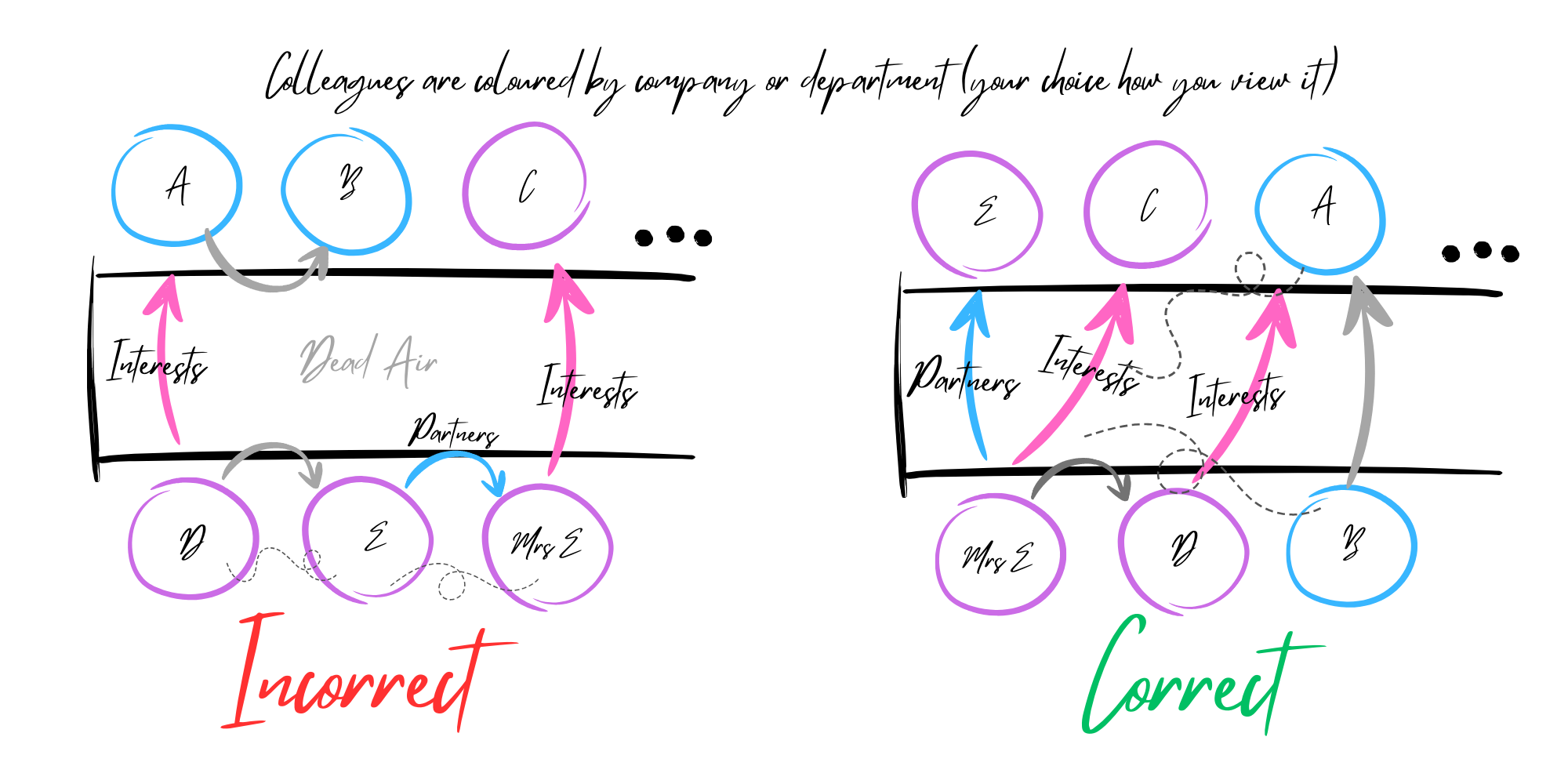
If you wanted to take this to the next level, speak to collague C before the event and get them to ask B about a particular story… or let colleague D know that A shares an interest.
Friends
Another ideal scenario, but for your friends, would be as so. Whilst we have a kind of isolated social group, we open the conversation across the table and allow two people who aren’t connected, to connect without feeling threatened by the environment.
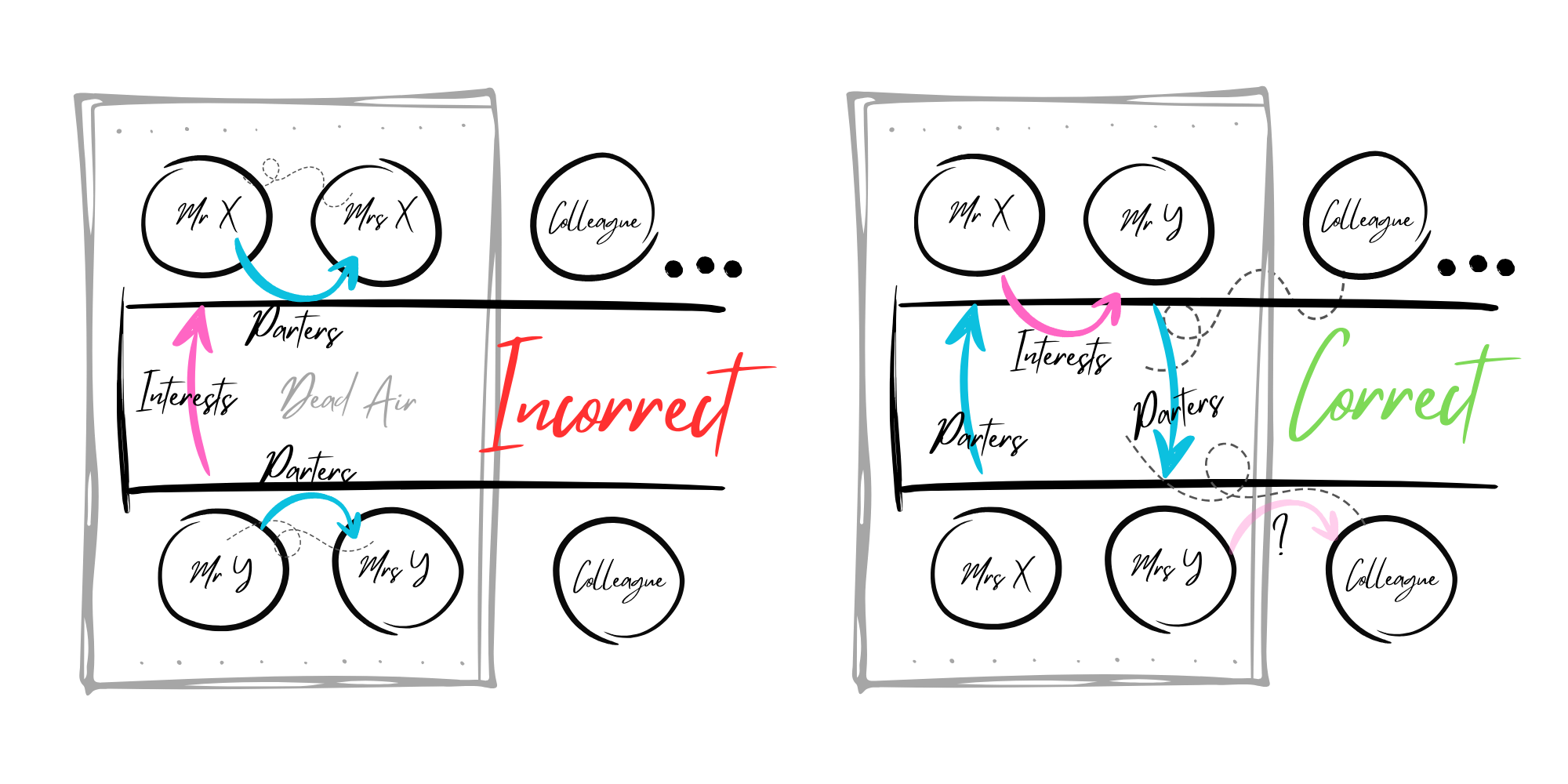
You are again connecting the strongest connections across the table, which forces open-air conversations and bridges the social divide. Mrs X and Mrs Y have a chance to complain about their partners bad habits and form a social bond… and by bridging the gap, you open the conversations to their neighbours joining in.
Round tables?
I haven’t bothered making the images for these yet, but the fundamental principles are the same. It’s just that sitting partners across from oneanother is a bad idea. Sit them next to eachother, but put their closer social connections across from them so that they have to talk over the table. Again, you’re just trying to minimise the opportnity for isolationism at the table, otherwise you’re just relying on extroverts to prop up the social vibes.
